Office Hours: M-F 9AM-6PM US Eastern

Where Passion Meets Profit
Where Passion Meets Profit
Where Passion Meets Profit
Blog post by TDW Closeouts on 1-Oct-2026 at 5:23pm Eastern Time
A truckload of liquidation merchandise has to get from the supplier's floor to yours, and how that happens is one of the larger decisions a truckload buyer makes. For Florida buyers the choice is unusually open. The state's concentration of wholesale warehouses in South Florida means many buyers can pick up a truckload themselves, while buyers elsewhere in the state and up the East Coast ship from the same warehouses along the Atlantic freight corridor.
What follows lays out how each approach works, what it requires, which buyers each one suits, and how to decide. TDW Closeouts supplies truckloads from its warehouse in Sunrise, Florida, to buyers who pick up at the dock and to buyers who ship across the state, the East Coast, and overseas, and the truckload liquidation in Florida overview describes what the company carries at that scale.
For buyers comparing truckload sources broadly, the guide to truckload liquidation websites and suppliers covers the wider market. The guide to liquidation truckloads for beginners covers the format itself. This article is about logistics.
Before pickup or shipping, a truckload is a full trailer of merchandise, typically twenty to twenty-six pallets depending on how it is built. The load is usually sorted by type, such as general merchandise, apparel, home goods, a specific retailer, or a mixed format, and it is either returns, overstock, or a combination. Retailer-specific formats such as Amazon truckload liquidation are among the most common loads moving through South Florida.
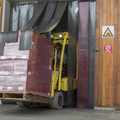
Receiving a truckload requires a dock or a workable liftgate arrangement, floor space for the full load, labor to process it, and a channel that absorbs the volume. Those requirements apply whether you pick up or ship. The difference between the two approaches is what happens between the supplier's dock and yours.
The truckloads section at a wholesale warehouse shows how loads are organized across retailers and categories.
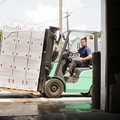
For South Florida buyers, and for buyers elsewhere who run their own trucks, picking up at the supplier's dock is the simplest arrangement. You or your driver bring a trailer, the supplier loads it, and you drive it to your facility.
The advantages are control and simplicity. You see the load being built. You control timing. There is no carrier to book, no pickup window to coordinate, and no freight bill. For buyers within an hour or two of the warehouse, pickup is almost always the better choice.
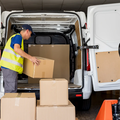
The requirements are a suitable truck and trailer, a driver qualified to operate it, and a receiving arrangement at your end. A box truck handles a partial load. A full truckload needs a tractor and a 53-foot trailer or the equivalent, and many buyers at that scale either own one or hire a local driver by the day.
Buyers in Miami-Dade, Broward, and Palm Beach can pick up from Sunrise routinely. The guide to Fort Lauderdale liquidation pallets gives a sense of the local market, and the broader Florida wholesale liquidation resource covers the state.
Buyers in Central Florida, the Tampa Bay area, Jacksonville, and the Panhandle usually ship rather than pick up, and intrastate freight from South Florida is straightforward. The lanes up the Turnpike and I-95 to Orlando and Jacksonville and across I-4 to Tampa are heavily trafficked, carriers run them constantly, and transit is typically a day.
The supplier either arranges freight or hands you a carrier contact, and a buyer should know which before ordering. Full truckload freight means the trailer carries only your load, which keeps handling to a minimum and timing predictable.
At your end, you need a dock or a liftgate arrangement, and you need to be ready to receive when the trailer arrives. Carriers bill for waiting time, and a truckload that cannot be unloaded promptly becomes a problem quickly.
For buyers within the state, freight is a minor logistical step, and a South Florida warehouse functions nearly as a local source with a day's delay.
South Florida sits at the southern end of the Atlantic freight corridor, which runs north through Georgia, the Carolinas, Virginia, and into the Northeast. It is one of the busiest lanes in the country, which means capacity is generally easier to secure than on lanes crossing the interior.
Buyers in Georgia, the Carolinas, Virginia, and further north regularly ship truckloads from South Florida warehouses. Transit runs from one to three days depending on destination. The guide to suppliers that ship to the East Coast covers how that corridor works and what to ask a supplier before shipping it.
The practical requirements are the same as intrastate shipping, with more attention to timing. A buyer should confirm the load is built and ready before booking a carrier, coordinate the pickup window with the supplier, and have receiving ready at the destination.
Distance adds coordination, and buyers shipping longer lanes generally prefer full truckloads over partial loads so that one shipment covers as much inventory as possible.
A large share of South Florida's truckload buyers are exporters consolidating containers for Latin America and the Caribbean. For them, the truckload moves from the supplier's dock to a freight forwarder or directly to the port, where it is loaded into a container.
This is a specialized version of shipping. The supplier needs to prepare the load for container consolidation, documentation has to be correct, and timing has to align with vessel schedules. A supplier with export experience handles this routinely. One without it does not.
TDW Closeouts provides customs assistance through its export and customs service, and the guide to wholesale liquidators exporting to Latin America covers how exporters source and move truckloads from Florida.
Booking freight before the load is confirmed is the most common. A carrier arrives, the load is not built, and the buyer pays for a wasted trip. Always confirm with the supplier that the truckload is ready before scheduling pickup.
Not preparing receiving is the second. A trailer arrives at a facility without a dock, without a liftgate arrangement, and without enough people to unload, and the carrier's clock is running. Walk through receiving before the load ships, not after.
Underestimating space is the third. A full truckload occupies far more floor once pallets are broken down than it does on the trailer. Buyers who have space for twenty-four wrapped pallets often do not have space for twenty-four pallets of unpacked merchandise.
Skipping the lane question is the fourth. A supplier who ships your corridor regularly knows transit times and what to expect. One who does not is guessing, and the guess shows up in your schedule. Ask directly how often they ship where you are.
Treating export like domestic freight is the fifth. Container consolidation has its own timing, documentation, and preparation requirements, and a supplier without export experience will not know them. Exporters should work with suppliers who handle that process routinely.
If you are within an hour or two and have access to a truck, pick up. The control and the absence of freight make it the better choice almost every time.
If you are further away within Florida, ship, and treat the South Florida warehouse as a local source with a day's delay.
If you are on the East Coast outside Florida, ship full truckloads along the corridor and plan receiving carefully.
If you export, work with a supplier who understands container preparation and customs, and coordinate timing with your forwarder.
In every case, confirm the load is built before anything moves, know who is arranging freight, and have receiving ready at your end.
TDW Closeouts supplies truckloads from its warehouse at 5501 Nob Hill Road in Sunrise, Florida, to buyers who pick up and buyers who ship. The dock is open Monday through Friday for pickup, and the warehouse loads at the dock for South Florida resellers and regional wholesalers who bring their own trucks and trailers.
For buyers shipping within Florida or up the East Coast, the team coordinates shipping with the buyer, and the Sunrise location puts loads at the southern end of the Atlantic corridor. For exporters, the company prepares truckloads for container consolidation and provides customs assistance. The floor carries truckloads of general merchandise, apparel, home goods, tools, housewares, seasonal, and retailer-specific loads from Amazon, Target, Walmart, Home Depot, department stores, and other sources, and a buyer planning freight can find out exactly which loads are built and ready before booking a carrier.
Website: TDW Closeouts: The Discount Warehouse
Call: 1-954-746-8000
For a Florida truckload buyer, the choice between picking up and shipping is mostly a question of distance. Within reach, pick up. Beyond it, ship along lanes that are among the best served in the country. Exporters work the port. In every case the supplier's preparation and communication determine whether the load arrives the way it was described.
Confirm, coordinate, and have receiving ready. The truckload buyers who do those three things rarely have logistics problems.
This article is provided for informational and entertainment purposes only. Any companies mentioned are not ranked in any particular order, and inclusion does not constitute an endorsement. Readers should conduct their own research and due diligence before selecting a supplier or making any purchasing decision.
 Export
  All
All  Department
  Pallet